Meltdowns are never fun. If your kid has had one of these, I probably need not explain why this is. But for the uninitiated, let me quickly introduce the phenomenon. As defined here, meltdowns are cases when your child is “so emotionally overwhelmed by unpleasant feelings that [they] can no longer control them or hide them from others”. With kids, this means tantrums that go on for over an hour, a strong sense of fear, anxiety or anger that are sometimes let out in extreme ways.
With Ray, meltdowns arrive when something unexpected barges into his life. Even though these things are hard for him, as he has grown up from a kid into the young man he is today, he has become more and more resilient to these – even when he is stressed inside, he is able to control and express these feelings calmly. Yet the stress is still there, and as his parents we really want to help with the core feeling when it arises.
“Unexpected” comes in many forms. It can be something small, like a guest he did not know was coming or a bad grade in a test. It can be something big, like vacation plans that he had been counting on that suddenly change. Or it can be something humongous, an international upheaval like a world-wide pandemic. Yep, I’m talking COVID-19.
I guess that one can cause anyone, kids and adults alike, to have a meltdown, but I digress.
I’m coming to this blog post a year after COVID entered our lives. I have not looked, but I’d venture a guess that hundreds if not thousands of blogs have been written about how to help your kids manage such a dramatic disruption to their lives. Still, I thought it would be helpful to write it all the same. For us, with all the challenges that COVID threw our way, I feel that Michelle and I learned a ton about how to help our kids cope with difficulty and emotional pressures. The technique I’ll show you here is the distilled version of one of the techniques we worked out over this year.
I hope it helps!
COVID vs. Family
The first weeks after COVID started, Israel went into lockdown. Everyone stayed home, shops closed down, schools moved to Zoom, etc. This was a hard time for lots of people, our family – and Ray – included.
After the second week of lockdown, as we began finding our balance as a family in this new reality, Ray came in to my room and said to me, “Dad, we need to talk. I’m worried!”
I sighed. Ray had been worried almost every day since the lockdown, and even before. The news sites were detrimental to his emotional well-being – they kept on changing their story about what to expect from this disease, creating confusion both mentally and emotionally. We had agreed with him to only look at the stat charts showing infection numbers once a day, and only in the first half of the day, so he did not freak out close to bedtime. I even made a point to review these stats together, so I could explain to him how to process this data intelligently, without the fear-mongering of the media.
But despite all my efforts, it was a daily event that Ray came and asked to share his fears with me. I tried explaining, comforting, hugging, distracting, joking – nothing seemed to work well. Nothing seemed to have a lasting impact on his well-being. To be honest, I was not sure there even was something I could do to help. Unlike meltdowns that I can see are over-reactions, it felt sort of legitimate to be scared over COVID – it’s not like I could tell him with confidence that “everything is going to be alright”.
“What is it?” I asked. Even though there was a part of me that was frustrated – with my lack of ability to help – I made space for him and listened.
“I’m worried that because of Corona my cousins and I won’t be friends anymore,” he said.
This made lots of sense. COVID introduced lots of uncertainty into our lives, and since Ray had invested so much, emotionally and technically, in his cousins in the past few years, it was only logical that he would worry about the impact of the pandemic on his relationship with them. Still, a part of me stirred in irritation. What is he talking about? it said. Of course his family won’t desert him. If anything, this can help him stay closer to them, support them when they are down, and vice-versa. I prepared myself for a cookie-cutter speech to calm him down and tell him to take it one day at a time.
Then, I stopped myself. I decided to take a step back, and try to approach this in a… different way. Instead of trying to calm him down, I wanted to actually spend time understanding why he was feeling this way.
Bring out the Flowcharts
I took Ray into my room and took out a pen and paper. At the top I wrote “COVID-19 is here” and at the bottom I wrote “Lose my cousins” or something like that, connecting them with an arrow – something like this:

“So, Ray,” I said, “does this express how you feel?”
“Umm, yes,” he said, nodding, looking very worried.
“OK,” I said. I already felt better. Writing things down does that for me.
I took a breath, giving me a moment to think. “Now, I want you to sketch for me how your life gets from the top to the bottom. COVID-19 happens, and therefore…?”
“We will be in Lockdown for a long time, months perhaps!” he said. His voice was shaking. I took my pen, and added a line from the top to the side, adding this new “step” in the process.
“And?” I said, “what next?”
“Well, I won’t be able to see my cousins all this time” he responded.
“A-ha,” I said, starting to see where this was going.
“And so, we won’t talk for a long time, months, and they will forget about me or move on to be friends with other people.” All the while that he was talking, I was sketching, till we came out with a diagram like this:
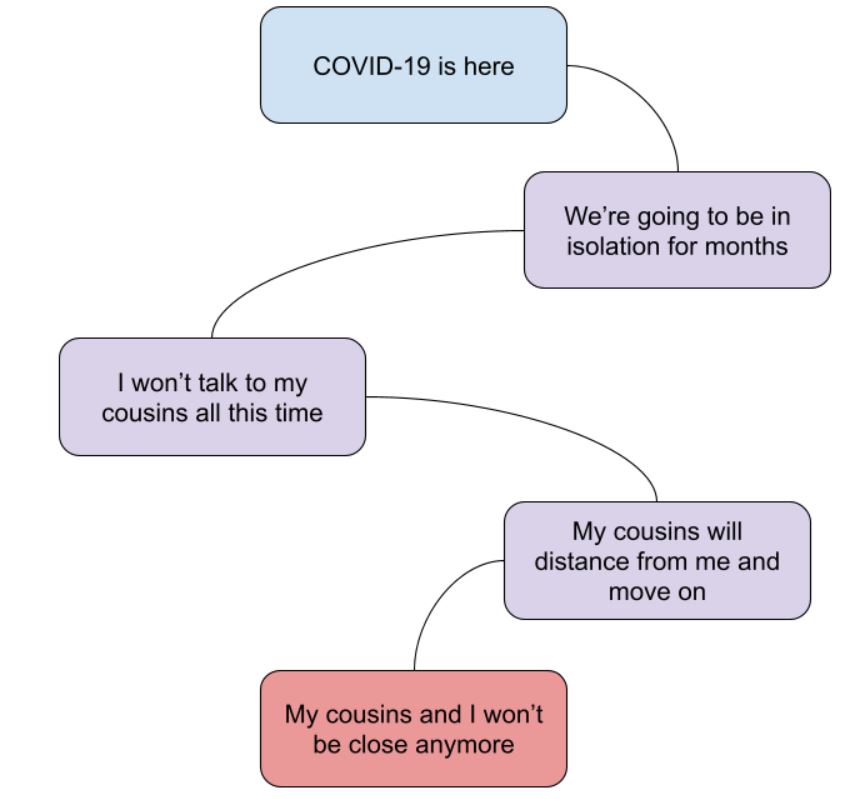
When he was done, I took a moment to review what we had sketched out. First thing I noticed was that Ray was not being irrational – the path that he drew here could happen. It was not an impossible situation.
Why am I not worried also? I asked myself, and the answer was clear. From my experience I knew that family doesn’t desert you like that – not close family at least, the kind that Ray had. Also, who knew how long and how strict the Lockdown would be? Some of these worries had very small chances of becoming a reality.
Two roads diverged
That’s when it hit me. Ray was seeing only one possible path into the future. It was the “worst-case” path, which is why he was worried. But what he didn’t realize was that there were also other paths that might be traversed, which ended much better for him. Since he did not consciously see them, however, he feared he was stuck in a one-way street to Doom.
So, I went ahead and asked him about the first one: “What if the lockdown is not permanent? What if this is the only one? What if there are breaks between lockdowns during which you can visit your cousins?” And as I said this, I added a line to the side. I continued with this for the other stages as well, something like this:
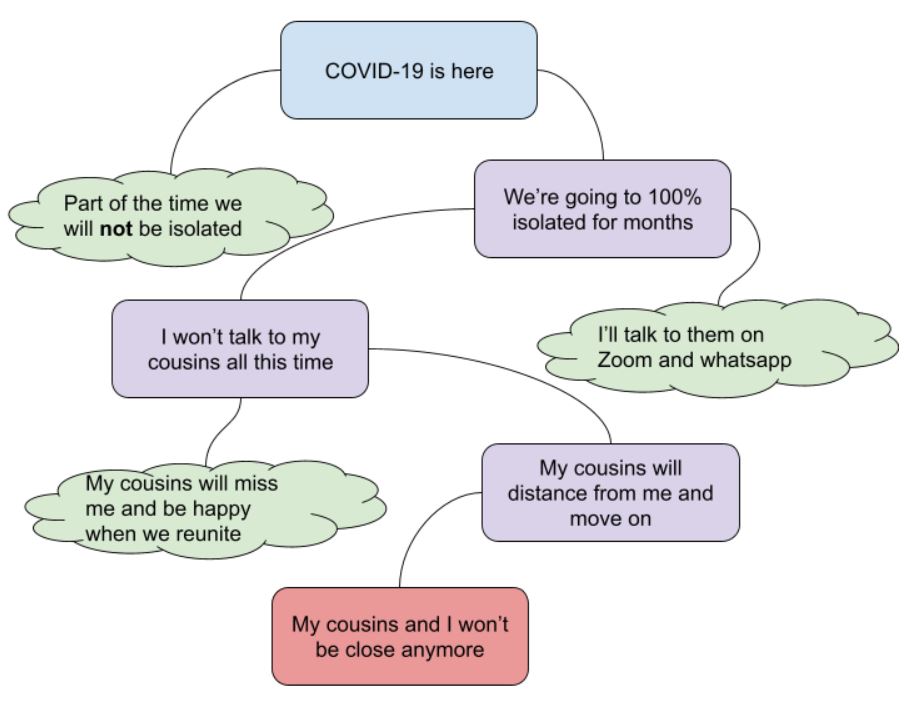
“You see, Ray?” I said, excited, “when we get to the green clouds, we are no longer on the path to the bad red destination you’re worried about, right?”
Ray looked at it. His hands held the paper like a lifeline. “I… guess,” he said.
“And while some of these are not under your control,” I continued, “like how long lockdown will be, you do control calling up your cousins on zoom and messaging them, right?”
“Yes,” he said grudgingly. (Ray does not like zoom calls. The F2F is very important to him. But this is better than nothing, right?)
He was still worried, but for the first time since COVID, I could sense that he had something to hold on to, something to give him – if not hope – control, even stability.
ProTip: Life is a Gamble
So that’s all there is to it: sketch the cause and effect, trace the path from one to the other, and see that at each step there are optimistic alternatives. We’ve used this technique a few times, and it works quite well.
One thing I’d like to add – an improvement we added later on. At times when the existence of a “positive route” is not enough to calm down, you might want to help your kid realize that the positive route is not just possible, but more likely. And the way to do this is with… gambling.
What I mean by this is that you focus on the “crossroads” you want to delve into and you say. “OK, let’s say I gave you $100, and you could gamble on which route you think will happen in reality – where would you put it?”
This sounds like a silly trick, but it helps, at least for Ray. The reason, I think, is that it forces a more rational, risk-assessment part of our brain to activate, and then it chooses the place with the least risk – that is, the lowest risk to our $100! When I’ve used this with Ray, he admitted that the more optimistic route is more likely, and this calmed him down greatly.
Last Thoughts
“What doesn’t kill you makes you stronger”, goes the phrase. Without COVID challenging us, I would most likely not have figured out this technique. Yet now my son has this tool, and so do we as parents, and it will serve us for the rest of our life.
And – I hope you can find support in this as well. If you try and use it, I’d love to hear back from you in the comments if it worked well. And if not, or you have tweaks that perhaps make it even more effective – let me know!
Till next time…
 GoodEnoughParenting